Classic Retro Bundle: A Practical Evaluation for Vintage Design Projects
Designers working on vintage-inspired projects often face a significant bottleneck: the sheer volume of time required to source appropriate typography. The market is saturated with millions of font variants, making the process of finding cohesive, high-quality retro typefaces an exhausting exercise in trial and error. For professionals and hobbyists alike who need to establish a specific aesthetic without spending weeks searching, curated collections offer a strategic solution. The Classic Retro Bundle is one such collection, designed to streamline this workflow by compiling eight distinct font packs into a single package.
This article evaluates the bundle’s composition, potential applications, and value proposition to help you determine if it aligns with your current design requirements. By examining the included typefaces and the broader context of retro design trends, we can assess whether this bundle serves as a practical tool for your creative toolkit or if alternative approaches might better suit your needs.
Understanding the Classic Retro Bundle Composition
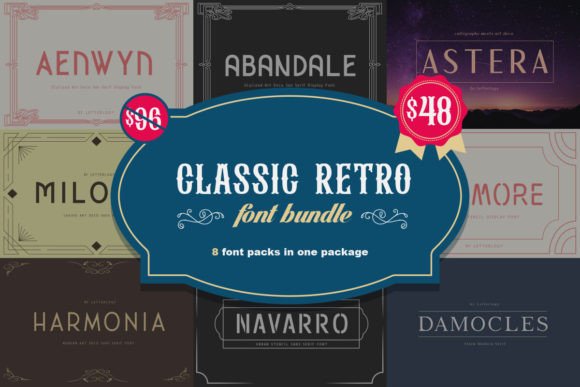
The core premise of the Classic Retro Bundle is convenience and curation. Rather than purchasing individual licenses for separate fonts, users gain access to eight pre-selected families that represent some of the most popular styles in the retro genre. The bundle is marketed with a discount compared to buying each item individually, which is a standard economic incentive for digital asset bundles. However, the true value lies in the stylistic range and usability of the included fonts.
The bundle includes the following eight typefaces:
- Aenwyn: Typically characterized by elegant, flowing lines, often suitable for sophisticated vintage branding.
- Abandale: A style that usually leans towards rustic or hand-crafted aesthetics, ideal for artisanal products.
- Astera: Often features geometric or space-age influences, reflecting mid-century modern trends.
- Belmore: Likely offers a sturdy, classic serif or slab-serif structure, providing readability and tradition.
- Damocles: This name suggests a sharper, perhaps more dramatic or gothic-inspired retro look.
- Harmonia: Implies balance and proportion, potentially a versatile sans-serif or soft serif for body text or subtle headers.
- Milonia: Often associated with decorative or script elements, adding a personal touch to designs.
- Navarro: Typically a bold, display-oriented font suitable for headlines and impactful statements.
By combining these varied styles, the bundle attempts to cover a broad spectrum of "retro" interpretations, from the 1950s diner aesthetic to 1970s bohemian vibes and early 20th-century industrial looks.
Why Designers Consider Curated Font Bundles
The primary driver for considering a product like the Classic Retro Bundle is efficiency. In professional design environments, time is a billable resource. Scouring multiple foundries, testing kerning pairs, checking language support, and ensuring license compatibility for individual fonts can consume hours. A curated bundle mitigates this friction by offering a pre-vetted selection.
Furthermore, consistency is crucial in branding. When fonts are bundled, they are often selected because they complement each other or share a certain quality threshold. This reduces the risk of pairing mismatched typefaces that clash in weight, proportion, or historical accuracy. For designers who are not typography specialists, having a set of fonts that are known to work well within a vintage context provides a safety net against common aesthetic pitfalls.
Benefits and Practical Applications
The most significant benefit of this bundle is its versatility across different media. The inclusion of both display fonts (like Navarro or Damocles) and potentially more readable options (like Harmonia or Belmore) allows for complete typographic systems. This is particularly useful for:
- Brand Identity Packages: Creating logos, business cards, and letterheads that require a cohesive vintage feel.
- Packaging Design: Products such as craft beers, artisanal coffees, or organic cosmetics often rely on retro typography to convey authenticity and heritage.
- Social Media Graphics: Quick-turnaround content for Instagram or Pinterest often benefits from bold, eye-catching retro headers that stand out in feeds.
- Event Invitations: Weddings, parties, or themed events frequently utilize nostalgic fonts to set the tone.
Another practical advantage is cost-effectiveness. If a designer anticipates needing multiple retro styles over the course of a year, purchasing them individually can become expensive. The bundled discount makes it a lower-risk investment for those building a foundational library of assets.
Tradeoffs and Considerations
While the convenience is appealing, there are tradeoffs to consider. First, the term "retro" is incredibly broad. A bundle may not perfectly align with a specific historical period you are targeting. For instance, if your project requires strict adherence to 1920s Art Deco typography, a general retro bundle might include fonts that are too modern or too rustic. It is essential to review the specific character sets and stylistic nuances of each included font before purchasing.
Second, popularity does not always equate to suitability. The description notes that these are "best-selling" and "most-favorited." While this indicates general approval, it also means these fonts may be widely used. If your goal is to create a unique, distinctive brand identity, using commonly available fonts might result in a generic look. Differentiation may require additional customization or pairing with less common typefaces.
Finally, technical compatibility should always be verified. Ensure that the file formats provided (usually OTF or TTF) are compatible with your design software and operating system. Additionally, check the licensing terms. Some bundles allow for unlimited commercial use, while others may have restrictions on the number of end products or require extended licenses for large-scale distribution.
When to Choose This Bundle vs. Alternatives
The Classic Retro Bundle is a strong fit for designers who need a quick, reliable solution for projects with a flexible definition of "vintage." It is ideal for freelancers managing multiple clients with varying aesthetic preferences, as the variety within the eight fonts allows for adaptation. It is also suitable for beginners who want to experiment with retro styles without the overwhelm of choosing from thousands of individual options.
However, alternatives may be worth considering in specific scenarios. If you are working on a highly specialized historical reproduction, custom lettering or purchasing specialized fonts from niche foundries may be necessary. Similarly, if you already possess a robust library of vintage typefaces, the marginal utility of this bundle may be low. In such cases, investing in advanced typography training or custom illustration tools might yield higher returns on your creative development.
Ultimately, the decision depends on your current project pipeline and existing assets. Evaluate the specific fonts included—Aenwyn, Abandale, Astera, Belmore, Damocles, Harmonia, Milonia, and Navarro—against your recent design briefs. If at least three or four of these styles match your typical client requests, the bundle offers tangible value. If only one font appeals to you, purchasing it individually may be more economical and prevent digital clutter.
By approaching the Classic Retro Bundle with a clear understanding of its contents and limitations, you can make an informed decision that enhances your design efficiency without compromising on creative quality. It serves as a practical tool for streamlining workflow, provided it is used strategically within the broader context of your design practice.